
Monday, November 30, 2015
New Property Manager

Tuesday, November 17, 2015
Preparing Your Building for Cold Weather

Start Early
No doubt that winter is the hardest season of the year in terms of wear-and-tear on buildings. Ice collects in cracks and spaces between bricks and masonry and contributes to façade deterioration; salt stains and eats away at metal and concrete; colder temperatures mean higher heating and electrical bills.
Windows
When it comes to water and cold penetration, windows are a definite weak point. Window frames and sashes should be inspected and repaired before winter arrives — preferably in the early fall. Caulking and sealant should also be checked, as it can become brittle with time. Cold and wet weather is less than ideal for working with these materials.
Also, the steel lintel—the piece of metal over every window head that supports the brick above the window—must be inspected. If allowed to rust, the lintels will eventually buckle and fail, causing the bricks above them to become loose and allowing water penetration and even more damage. Lintel inspections should be done with plenty of time before winter, because repairing them is a major task.
Walkways
Cement can't be poured in the winter because of the cold temperatures, so paving pros recommend getting repairs done by October’s end to beat the freezing temperatures.
Check for broken areas and cracks that could become tripping hazards when hidden by a dusting of snow.
Keep the Heat In
With energy prices high and many buildings watching their funds more closely than ever, conservation has become a serious concern for boards and residents as well. There are a number of measures that a building staff and individual owners can take to ensure that heat is staying inside the building. First, search for areas where heat can escape – windows and outside doors are big culprits. Check the gap between the bottom of the door and the saddle, as well as the gap around the door frame. For a reasonable amount of money, you can weather-strip the door, not only to save money, but to improve the comfort level inside the units.
Also, check the basement to make sure no air or heat is escaping. If your building has a boiler system, that should be cleaned and checked yearly as well.
During the heating season, building personnel should closely monitor fuel consumption relative to past consumption on similar-temperature days and address any large increases right away.
Keep the Rain Out
A building's roof is another crucial component in its ability to resist the cold. Flat roofs should be prepared with an ultraviolet roof coating, preferably before October. The coating is a relatively inexpensive petroleum-based product that is painted onto the roof. It contains reflective silver additives and creates a barrier that will insulate your building and protect it against ice and snow.
Additionally, roof drains should be cleared to prevent blockages that could cause icy build-up ... and possibly leaks.
Pitching In
Residents can help prepare for winter by lowering thermostats just a few degrees (and perhaps installing thermostats with a timer feature), and alerting the super or manager of anything that needs to be repaired.
Don’t wait until the cold weather actually arrives to start thinking about winterizing your building!
Monday, November 2, 2015
Project Spotlight - Wall Repair
We recently completed repair of a large retaining wall at Hamlin Court in Middletown. We'd gotten reports from residents about bricks and mortar popping out of the wall. When we inspected it, we discovered some pretty serious damage, and more importantly, a big safety concern. Water had gotten in behind the brick, and after many years of freezing and thawing, the wall was in very bad shape. Here are some photos:


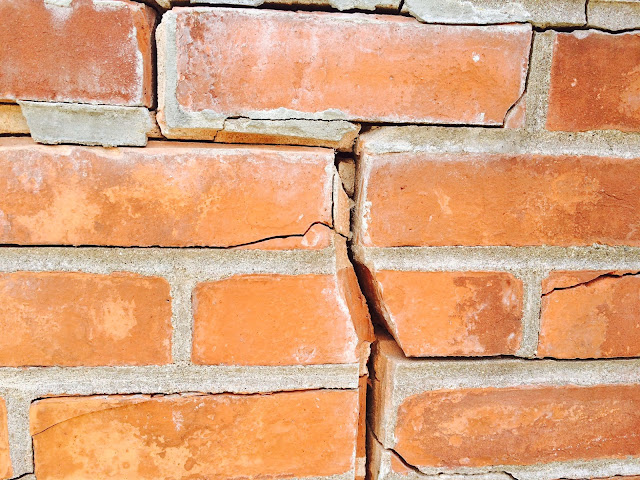
We worked with several contractors to get bids on the project, and after a meeting with the Board, we hired a local company to work on the project. Their first step was to take down the brick facade. A dumpster was rented, and the demolition began. It became obvious pretty quickly that there were problems. Previously, a section of the wall had been repaired. When the brick face was removed, a pretty nice concrete wall was revealed, and it was cleaned up and painted. Not the case here! What we found was a mess ... broken bricks, concrete pieces and various debris in front of a decrepit concrete wall.


 Re-bar was added to support the new concrete ... LOTS of re-bar! Drain holes were added as well, to allow water to move away from the wall instead of building up behind it and freezing. The new concrete was poured. After a few days' drying time, the new wall was revealed.


The contractors moved on to the next section. Luckily, there was less debris behind the brick, and the concrete wall was in much better shape than the one next to it. Minor repairs were done, and the wall began to look really nice!


After a consultation with the Board about color and type of finish, a concrete stain that matched the brick building was chosen. Paint was also offered as an option, but the contractor felt that water might seep through the porous concrete and cause the paint to peel. Here's a photo of the wall after a couple of coats of the stain were applied.

We are so happy with how this project turned out, as are our clients. They were very pleased with the contractor's professionalism and attention to detail ... and how quickly the job was completed. What a great way to wrap up the warm weather season!


The contractor came up with a plan to remove the debris and repair the concrete wall in a way that would be stable and safe, yet remain affordable to the Association. First steps were to secure the wall to avoid a collapse, then put in wooden forms for the concrete.


The contractors moved on to the next section. Luckily, there was less debris behind the brick, and the concrete wall was in much better shape than the one next to it. Minor repairs were done, and the wall began to look really nice!


After a consultation with the Board about color and type of finish, a concrete stain that matched the brick building was chosen. Paint was also offered as an option, but the contractor felt that water might seep through the porous concrete and cause the paint to peel. Here's a photo of the wall after a couple of coats of the stain were applied.

We are so happy with how this project turned out, as are our clients. They were very pleased with the contractor's professionalism and attention to detail ... and how quickly the job was completed. What a great way to wrap up the warm weather season!
Wednesday, October 28, 2015
APARTMENT FOR RENT

Middletown: 2 bedroom/2 bath, vaulted ceiling in living
room, fireplace, separate dining area, tennis courts on property,
$1,200/month ... please call us ASAP for details ... this one will go
quick!
Wednesday, October 7, 2015
Premier Property Management Receives 2015 Best of Enfield Award
Each
year, the Enfield Award Program identifies companies that we believe
have achieved exceptional marketing success in their local community and
business category. These are local companies that enhance the positive
image of small business through service to their customers and our
community. These exceptional companies help make the Enfield area a
great place to live, work and play.
Various
sources of information were gathered and analyzed to choose the winners
in each category. The 2015 Enfield Award Program focuses on quality,
not quantity. Winners are determined based on the information gathered
both internally by the Enfield Award Program and data provided by third
parties.
About Enfield Award Program
The
Enfield Award Program is an annual awards program honoring the
achievements and accomplishments of local businesses throughout the
Enfield area. Recognition is given to those companies that have shown
the ability to use their best practices and implemented programs to
generate competitive advantages and long-term value.
Saturday, September 19, 2015
ICE DAMS, INSURANCE DEDUCTIBLES, AND THE ALLOCATION OF REPAIR COSTS
By Scott J. Sandler, Esq.
On September 15, 2015, the Connecticut Condominium Owners Coalition (“CCOC”) posted an article by Patricia Ayars, Esq. titled Ask Attorney Pat: How to Get the Association to Pay and Repair Ice Damming.
This article depicts board members as stubborn jackasses in need of a
good clubbing with a two-by-four, who are wrongly refusing to pay to
repair units damaged by ice dams. A more appropriate title for the
article would have been How to Get Your Neighbors to Pay to Repair Damage to Your Unit that Should Be Covered by Your Insurance Policy.

Per-Unit Deductibles
The
insurance industry is employing more and more creative methods to avoid
having to pay claims. The imposition of per-unit deductibles is one of
these methods.
Insurance
companies that sell master insurance policies to associations are now
more commonly requiring that the policy contain a per-unit deductible
for damage caused by ice dams. The policy then treats each damaged unit
as a separate occurrence.
On
a per-unit scale, damage from ice dams often costs less than the amount
of the deductible. However, because a large number of units may be
damaged, the total repair cost that is not covered by the master policy
can be substantial.
Master Policies and Homeowner Policies: Primary and Secondary Coverage
Section
47-255 of the Common Interest Ownership Act (“CIOA”) requires the
association of most communities to purchase a master insurance policy
that covers both the units and the common elements against claims for
property damage. CIOA does not require the association to insure the
units in communities where the units are completely detached, or where
the units are constructed as duplexes.
Section
47-255 also requires that, in the event of a loss, the master policy
provide “primary” coverage. CIOA does not state that the master policy
will provide “exclusive” coverage. The distinction between primary and
exclusive is one of major significance, and it is one that is often
overlooked.
Most
individual unit owners have purchased their own insurance policies.
These policies provide for coverage for damage to the unit, as well as
coverage for the owner’s personal property.
When
there is damage to the property, the master policy provides primary
coverage. This means that the association must first look to the master
policy for coverage.
However,
nothing in CIOA prohibits the association and the owners from seeking
secondary coverage from another source of insurance, such as the
insurance purchased by the unit owner. And doing so makes perfect
sense, since the coverage is already in place and is designed to protect
the owners from bearing the cost of repair. The very reason unit
owners pay insurance premiums is to protect them from this cost.
Repair Costs as Common Expenses
Section 47-255 of CIOA states that the cost of repair that exceeds available insurance proceeds is a common expense.
First,
CIOA refers to “available” insurance proceeds. The provision is not
limited to just the proceeds available under the master insurance
policy. Proceeds may also be available under the owner’s policy.
Second,
while common expenses are generally shared by all owners, there are a
number of situations where CIOA permits the association to assess an
expense against just a few or even only one owner. Subsection 47-257(c)
states that the declaration of the community may require the following:
1. That the association assess the cost of maintaining,
repairing, or replacing a limited common element solely against the unit
that it serves;
2. That the association assess the cost of insurance against units in proportion to risk;
3. That the association assess the cost of utilities in proportion to usage; and
4. That the association assess a common expense, or any potion
thereof, that benefits less than all units, solely against the units
that receive the benefit.
The
cost of repairing a unit damaged by an ice dam is an expense that
benefits that unit. While that cost is a common expense, the
declaration may require the association to assess that expense solely
against the damaged unit pursuant to Subsection 47-257(c) of CIOA.
We Have Met the Enemy and They Are Us
Unit
owners, including board members, are all too often subject to the “We
vs. Them” mentality. They forget the most important part of living in a
common interest community, the part about it being a “community.”
To
save money, board members will identify expenses to push back onto
individual owners. Likewise, the individual owners will expect the
association pay for anything and everything that is related to the good
and welfare of the community.
The
fact that gets lost in these competing views is that, in the end, there
is only one source of income for the community: the individual owners.
Either the owners pay for expenses directly, or they pay common charges
which the association uses to pay the expenses. But no matter what,
the owners pay.
Protecting the Community
If
the association really wants to save the community money, and to
insulate owners from the burden of uncovered repair costs, it must look
for resources outside of the community. That is why it is so important
to tap into the insurance purchased by individual owners as secondary
coverage.
Attorney
Ayars focuses her article on forcing the association to pay for the
cost of repairing damaged units. That only results in costing all
owners more money.
The
real focus should be on how to tap into sources of insurance other than
just the master policy, so that more of the expenses are paid from
sources outside of the community.
Many insurance companies that sell policies to individual owners will cover these costs without question.
However,
some companies have engaged in the same flawed interpretation of CIOA
as Attorney Ayars has. They see “primary” and think “exclusive.” They
see “common expense” and think of the general rule of assessing all
owners, not just those that benefit from the expense. However, if the
declaration specifically requires the association to assess these repair
costs solely against the damaged units, then even these companies will
cover these costs.
It
is for this reason that the second edition of the Common Interest
Ownership Manual, published by the Connecticut Bar Association, includes
a model declaration that provides for assessing these costs against the
damaged units. The authors of the manual, having consulted with other
attorneys, insurance professionals, and the Connecticut Insurance
Department, concluded that the best way of protecting the community from
the burden of these costs was to require the association to assess
these costs against the damaged units, thus triggering coverage under
the polices purchased by individual owners.
Responsibility to Repair
Attorney
Ayars is correct when she states that the association cannot refuse to
make repairs when units are damaged by events covered by property
insurance. Section 47-255 of CIOA requires the association to make
these repairs. Once the adjusters hired by the association and
homeowner’s insurance companies have fully inspected and documented the
damage, the association must proceed with the repairs as promptly as
possible.
It
is understandable that angry and frustrated owners and board members
will point fingers and attempt to avoid incurring additional expenses.
However, suggesting that the board members should be clubbed with a
piece of lumber is not the answer. The real answer is to structure the
responsibility for the loss in a way that protects the entire community
against the expense.
Attorney
Sandler is a partner in the law firm of Perlstein, Sandler &
McCracken, LLC, located in Farmington, Connecticut. His firm represents
over 400 condominium and homeowner associations throughout the state.
Mr. Sandler is a fellow of the Community Associations Institute’s
College of Community Association Lawyers. Since 2010, he has served as
the chairman of the Legislative Action Committee of the Connecticut
Chapter of the Community Associations Institute. He is also a member of
the Institute’s Government & Public Affairs Committee. Mr. Sandler
served the Institute as president of its Connecticut Chapter from 2008
through 2009.
Monday, September 14, 2015
Fall Property Maintenance Checklist for Condominiums

Sadly, summer is coming to a close and winter is right around the corner. At this time of year, it’s especially important to keep up with seasonal maintenance on your property. Here are some items to consider before the weather starts getting too cold:
Clear gutters and downspouts. Before autumn dumps some more leaves into your gutters, they should be inspected for dirt, leaves and other debris. Downspouts should be cleared of clutter and all the fittings should be examined.
Clean the chimney. If your property has a chimney, hire a professional chimney sweep to make sure the damper and flue are working properly, the flashing is protected against water leakage, and no animals have made their nest inside.
Repair the walkways. Before the ground becomes slippery with rain or covered in snow, your building’s walkways should be inspected for cracks, uneven pavement, or any opportunities for residents to trip and get hurt.
Remind residents to change the air filters. After a summer of using the central air system, filters can get dirty. Also remind them to waterproof or remove window air conditioning units before fall sets in.
Check for leaks. Prevent broken and burst pipes in the winter by having the plumbing in each unit inspected for leaks. Get up into the attic space after a rainstorm and make sure there are no leaks in the roof, chimney, or skylights. Remind residents to keep their indoor temperature set high enough setting to prevent frozen pipes.
Our clients can schedule a fall inspection with us by giving us a call at 877-208-4570. You can also visit us online.
Subscribe to:
Posts (Atom)